
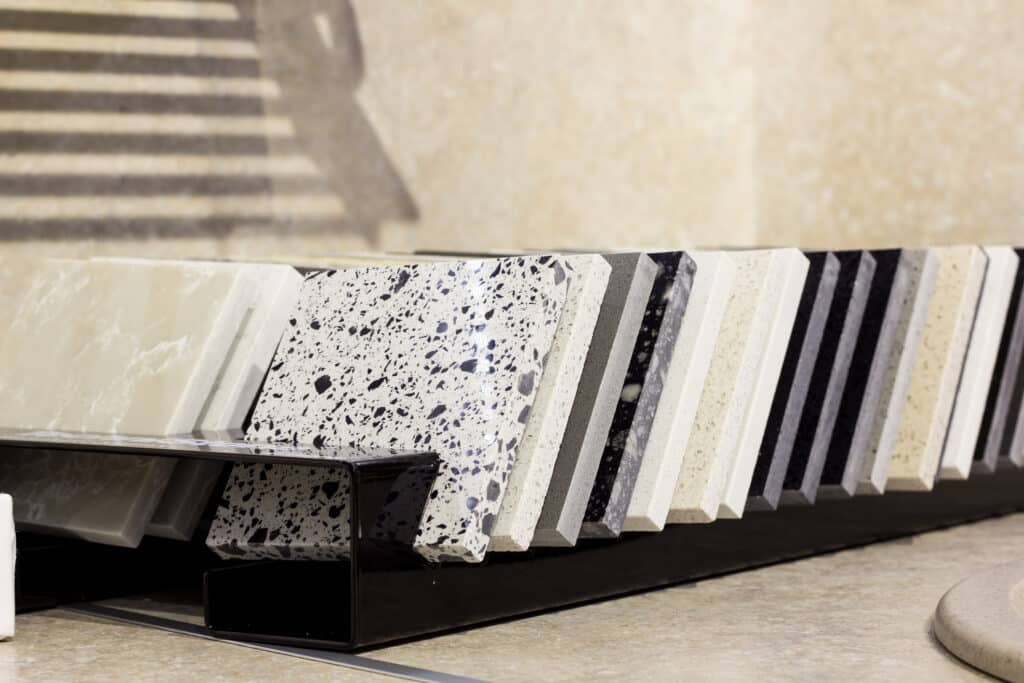
Quartz is the countertop material American homeowners choose most often. The 2026 U.S. Houzz Kitchen Trends Study, as reported by Builder, found engineered quartz in 32% of renovated kitchens. Yet most people who buy it have never been told what it actually is.
Knowing how quartz countertops are made helps you understand why it performs the way it does and what to look for when you compare brands. Here is the journey from raw mineral to finished countertop, as we explain it to homeowners in Fort Wayne and across northeast Indiana.
Step 1: Natural Quartz Is Crushed and Blended
Quartz countertops start with natural quartz, one of the hardest minerals found in nature. Manufacturers crush it into aggregate ranging from fine powder to small granules.
That quartz is blended with polymer resins and pigments. Caesarstone, one of the brands we carry, states that its quartz surfaces are made with roughly 90% quartz, with the rest made up of resins and pigments. The resin binds the quartz together, and the pigments create the color.
Step 2: Patterns and Veining Are Built In
Before the mix is pressed, manufacturers layer and blend colors to create patterns. Some products are uniform and speckled. Others are designed to look like marble, with veins added by hand or by machine.
Pro Tip: Ask whether a marble-look quartz has veining that runs through the full thickness of the slab. Through-body veining looks natural on mitered and waterfall edges, while surface-only veining can show a plain band once the edge is cut.
Step 3: The Slab Is Compressed Under Vacuum and Vibration
The blended mix is spread into a slab-sized mold. Caesarstone describes applying 100 tons of pressure through a vacuum and vibration process. The vacuum pulls out air pockets, and the vibration and pressure pack the particles tightly together.
This step is what makes quartz so dense and non-porous. Without trapped air or open pores, liquids have nowhere to soak in, which is why quartz does not need sealing the way many natural stones do.
Experience the Wise Stone Choice Difference
Curious How Are Quartz Countertops Made and Which One Fits Your Home? Visit Wise Stone Choice.
Ever wondered how quartz countertops are made? See how raw quartz becomes a slab, then a finished countertop, with insights from Wise Stone Choice in Fort Wayne, Indiana.
Step 4: Curing, Calibrating, and Polishing
After pressing, the slabs are cured so the resin hardens fully. They are then ground to a consistent thickness and polished, or given a honed or textured finish. Each slab is inspected before it ships to distributors and fabricators like us.
Step 5: We Turn the Slab Into Your Countertop
This is where the factory ends and the craftsmanship begins. At Wise Stone Choice, the process starts with a showroom visit, where you select color, edge profile, and sink. After your cabinets, appliances, and fixtures are in place, we take laser-accurate measurements, then cut, finish, and install your countertops. See every step on our design and installation process page.
Pro Tip: Because quartz contains resin, manufacturers generally advise using trivets for hot pans and keeping standard quartz indoors, out of direct sunlight. If you are planning an outdoor kitchen, ask us about better-suited materials on our outdoor countertops page.
Why Brand Matters When You Buy Quartz
Because every manufacturer uses its own formulas, equipment, and quality control, quartz is not all the same. We are proud to carry top brands like Caesarstone, Silestone, Vicostone, Metro-Quartz, One-Quartz, and Color Quartz.
Compare options on our quartz countertops page, or weigh the trade-offs in our guide to quartz countertop pros and cons.
See Quartz Up Close in Fort Wayne
With more than 25 years of experience, Wise Stone Choice helps Fort Wayne homeowners choose and install the right surface for their kitchens, baths, and more. Our showroom and indoor slab gallery at 5733 US 930 E. let you compare quartz side by side.
Request a free quote or call (260) 749-8062 to start your project.
